Normed Spaces
In order to extend the analytical study about functions of single variable to multiple variables, we need to study the structure of vector spaces. There is no harm to do so under a more abstract setting, which leads to the normed spaces. More in-depth study of vector spaces itself can be found in linear algebra.
Definition. Let $V$ be a vector space over a field $\mathbf{F}$. The real valued function $\Vert \cdot \Vert: V \to \mathbf{R}$ on $V$ is called a norm on $V$ and $V$ is called a normed vector space if
$\Vert x \Vert \ge 0$ for all $x \in V$ with equality iff $x = 0$;
$\Vert x + y \Vert \le \Vert x \Vert + \Vert y \Vert$ for all $x, y \in V$;
$\Vert \lambda x \Vert = \vert \lambda \vert \Vert x \Vert$ for $\lambda \in \mathbf{F}$ and $x \in V$.
In a normed vector space, a metric $\rho$ may be defined by $\rho(x, y) = \Vert x - y \Vert$. Similarily, two norms on the same space can be equivalent and the topological properties of the space do not depend on which norm we choose.
Definition. Let $V$ be a vector space. Two norms $\Vert \cdot \Vert$ and $\Vert \cdot \Vert’$ on $V$ are Lipschitz equivalent if there exists positive real constants $\lambda$ and $\mu$ such that
\[\lambda \Vert x \Vert \le \Vert x \Vert' \le \mu \Vert x \Vert\]for all $x \in V$.
Definition. Let $(V, \Vert \cdot \Vert)$ be a normed space. A subset $E \subseteq V$ is bounded if there is some $r > 0$ such that
\[E \subseteq B_r(0)\]
Definition. Let $(V, \Vert \cdot \Vert)$ be a normed space. A sequence $(x_n)$ in $V$ is convergent to $x \in V$, denoted by $x_n \to x$, if $\Vert x_n - x \Vert \to 0$, i.e.
\[(\forall \varepsilon > 0)(\exists N)(\forall n > N)\; \Vert x_n - x \Vert < \varepsilon\]
Proposition. Let $(V, \Vert \cdot \Vert)$ be a normed space. Then
$x_n \to x$ and $x_n \to y$ implies $x = y$;
$x_n \to x$ implies $\lambda x_n \to \lambda x$;
$x_n \to x$ and $y_n \to y$ implies $x_n + y_n \to x + y$.
Proof.
$\Vert x - y \Vert \le \Vert x - x_n \Vert + \Vert x_n - y \Vert \to 0$ so $\Vert x - y \Vert = 0$ and $x = y$.
$\Vert \lambda x_n - \lambda x \Vert = \vert \lambda \vert \Vert x_n - x \Vert \to 0$.
$\Vert (x_n + y_n) - (x + y) \Vert \le \Vert x_n - x \Vert + \Vert y_n - y \Vert \to 0$.
Equivalent norms on the same space preserve boundedness and convergence.
Proposition. If $\Vert \cdot \Vert$ and $\Vert \cdot \Vert’$ are Lipschitz equivalent norms on a vector space $V$, then
A subset $E \subseteq V$ is bounded with respect to $\Vert \cdot \Vert$ iff it is bounded with respect to $\Vert \cdot \Vert’$;
A sequence $(x_n)$ converges to $x$ with respect to $\Vert \cdot \Vert$ iff it converges to $x$ with respect to $\Vert \cdot \Vert’$.
Proof.
Both are direct from the definition of equivalence and the sandwich principle.
We can now explore some important examples.
Finite-dimensional Spaces
All finite-dimensional vector spaces are isomorphic to $\mathbf{R}^n$ so we will focus on that. We start with something familiar.
Proposition. The Euclidean/usual norm defined by
\[\Vert x \Vert_2 = \sqrt{x_1^2 + ... + x_n^2}\]is a norm on $\mathbf{R}^n$.
Proof.
We will just prove the triangle inequality by the Cauchy-Schwarz inequality, i.e.
\[\begin{align*} \Vert x + y \Vert^2 &= \sum_{i=1}^n (x_i + y_i)^2 \\ &= \Vert x \Vert^2 + \Vert y \Vert^2 + 2 \sum_{i=1}^n x_i y_i \\ &\le \Vert x \Vert^2 + \Vert y \Vert^2 + 2 \Vert x \Vert \Vert y \Vert \\ &= \left( \Vert x \Vert + \Vert y \Vert \right)^2 \end{align*}\]
We can also have the following norms on $\mathbf{R}^n$:
\[\begin{align*} \Vert x \Vert_1 &= \sum \vert x_i \vert \\ \Vert x \Vert_p &= \left( \sum \vert x_i \vert^p \right)^{1/p} \\ \Vert x \Vert_\infty &= \max\Set{\vert x_i \vert : 1 \le i \le n} \end{align*}\]in which as $p \to \infty$, $\Vert x \Vert_p \to \Vert x \Vert_\infty$.
Proposition. Convergence in $\mathbf{R}^n$ is equivalent to coordinate-wise convergence, i.e. $x_n \to x$ iff $(x_n)_i \to (x)_i$ for $1 \le i \le n$.
Proof.
($\Rightarrow$) Let $\varepsilon > 0$. There exists $N$ such that for all $n > N$,
\[\Vert x_n - x \Vert^2 = \sum_{i=1}^n ((x_n)_i - (x)_i)^2 < \varepsilon^2\]so each of the term $\vert (x_n)_i - (x)_i \vert < \varepsilon$.
($\Leftarrow$) Let $\varepsilon > 0$. There exists $N_i$ such that for all $n > N_i$, $\vert (x_n)_i - (x)_i \vert < \varepsilon / \sqrt{n}$. By having $N = \max \Set{N_i}$, we have for all $n > n$,
\[\Vert x_n - x \Vert = \left( \sum_{i=1}^n ((x_n)_i - (x)_i)^2 \right)^{1/2} < \varepsilon\]
Infinite-dimensional Spaces
We will extend the notions on $\mathbf{R}^n$ to infinite sequences with some care. Let $\mathbf{R}^{\mathbf{N}}$ be the set of all infinite real sequences $(x_n)$ which is a vector space with termwise addition and scalar multiplication. By considering subspaces of $\mathbf{R}^{\mathbf{N}}$ with some restrictions, we can define different norms accordingly. The vector subspaces are
\[\begin{align*} \ell^1 &= \Set{(x_n) \in \mathbf{R}^{\mathbf{N}} : \sum \vert x_n \vert < \infty } \\ \ell^2 &= \Set{(x_n) \in \mathbf{R}^{\mathbf{N}} : \sum \vert x_n \vert^2 < \infty } \\ \ell^p &= \Set{(x_n) \in \mathbf{R}^{\mathbf{N}} : \sum \vert x_n \vert^p < \infty } \\ \ell^\infty &= \Set{(x_n) \in \mathbf{R}^{\mathbf{N}} : \sup \vert x_n \vert < \infty } \end{align*}\]and the corresponding norms are
\[\begin{align*} \Vert (x_n) \Vert_1 &= \Vert (x_n) \Vert_{\ell^1} = \sum \vert x_n \vert \\ \Vert (x_n) \Vert_2 &= \Vert (x_n) \Vert_{\ell^2} = \left( \sum \vert x_n \vert^2 \right)^{1/2} \\ \Vert (x_n) \Vert_p &= \Vert (x_n) \Vert_{\ell^p} = \left( \sum \vert x_n \vert^p \right)^{1/p} \\ \Vert (x_n) \Vert_\infty &= \Vert (x_n) \Vert_{\ell^\infty} = \sup \vert x_n \vert \end{align*}\]Proposition. The $\Vert (x_n) \Vert_{\ell^2}$ satisfies the triangle inequality.
Proof.
Since we can write
\[\Vert (x_n) \Vert_{\ell^2} = \lim_{n \to \infty} \Vert (x_1, ..., x_n) \Vert_2\]so the triangle inequality of Euclidean norm implies triangle inequality for $\ell^2$.
Unlike the norms defined for finite-dimensional spaces, the similar norms for infinite-dimensional spaces are not necessary equivalent.
Proposition. For the space $\ell^2$, the norms $\Vert (x_n) \Vert_2$ and $\Vert (x_n) \Vert_\infty$ are not equivalent.
Proof.
Obviously, we have $\Vert (x_n) \Vert_\infty \le \Vert (x_n) \Vert_2$. However, there is no constant $mu$ such that $\Vert (x_n) \Vert_2 \le \mu \Vert (x_n) \Vert_\infty$. For example, the sequence with first $b^2 + 1$ terms $1$ and $0$ for the rest doesn’t satisfy the inequality.
Function Spaces
Consider the set of continuous real functions on $[a, b]$, denoted by $C[a, b]$, we can define the norms by
\[\begin{align*} \Vert f \Vert_{L^1} &= \Vert f \Vert_1 = \int_a^b \vert f \vert \,dx \\ \Vert f \Vert_{L^2} &= \Vert f \Vert_2 = \left( \int_a^b \vert f \vert^2 \,dx \right)^{1/2} \\ \Vert f \Vert_{L^p} &= \Vert f \Vert_p = \left( \int_a^b \vert f \vert^p \,dx \right)^{1/p} \\ \Vert f \Vert_{L^\infty} &= \Vert f \Vert_\infty = \sup \vert f \vert \end{align*}\]The $L^\infty$ norm is also called the uniform norm or supremum norm.
Proposition. [Cauchy-Schwarz inequality for integrals] Suppose that $f, g \in C[a, b]$ with $f, g \ge 0$, then
\[\int_a^b fg \,dx \le \left( \int_a^b f^2 \,dx \right)^{1/2} \left( \int_a^b g^2 \,dx \right)^{1/2}\]Proof.
If $\int_a^b f^2 \,dx = 0$, then $f = 0$ since $f$ is continuous. The inequality is obviously true.
Let $A^2 = \int_a^b f^2 \,dx \not= 0$ and $B^2 = \int_a^b g^2 \,dx$. For all $t$, we have
\[\int_a^b (g - tf)^2 \,dx = B^2 - 2t \int_a^b fg \,dx + t^2 A^2 \ge 0\]and therefore
\[\left( \int_a^b fg \,dx \right)^2 - A^2 B^2 \le 0\]
The Cauchy-Schwarz inequality again implies the triangle inequality and therefore the $L_2$ norm is actually a norm.
Similar to infinite-dimensional spaces, the norms are not necessary equivalent.
Proposition. Let $V = C[0, 1]$. The norms $\Vert f \Vert_1$ and $\Vert f \Vert_\infty$ are not equivalent.
Proof.
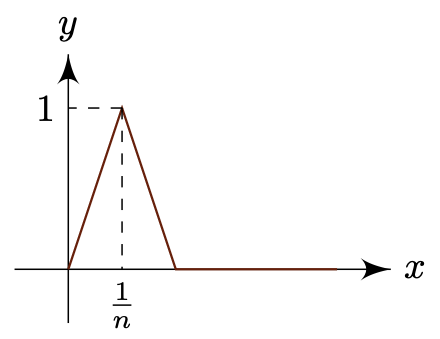
Obviously, we have $\Vert f \Vert_1 \le (1 - 0) \Vert f \Vert_\infty$. Howver, there is no constant $\mu$ such that $\Vert f \Vert_\infty \le \mu \Vert f \Vert_1$ for all $f$. For example, consider the sequence of functions $f_n$ of the form
and we have $\Vert f_n \Vert_\infty = 1$ but $\Vert f_n \Vert_1 = 1/n \to 0$.
Bolzano-Weierstrass Theorem
The Bolzano-Weierstrass Theorem can be generalized for finite-dimensional normed spaces.
Theorem. [Bolzano-Weierstrass Theorem in $\mathbf{R}^n$] Suppose that $(x_n)$ is a bounded sequence of $\mathbb{R}^n$ (with respect to say the Euclidean norm). Then there is a subsequence $(x_{n_k})$ which converges.
Proof.
For $n = 1$, we have proved before using bisection. Asumme it is true for $\mathbf{R}^{n-1}$. Let $(x_k) = (((x_k)_1, …, (x_k)_{n-1}, (x_k)_n))$ be a bounded sequence in $\mathbf{R}^n$. Let $(y_k) = (((x_k)_1, …, (x_k)_{n-1}))$ and we have
\[\Vert y_k \Vert^2 + \vert (x_k)_n \vert^2 = \Vert x_k \Vert^2\]so both $(y_k)$ and $((x_k)_n)$ are bounded. By induction hypothesis, there is a subsequence $(y_{n_k})$ converges to $y$ and by Bolzano-Weierstrass theorem in $\mathbf{R}$ there is a further subsequence $((x_{n_k’})_n)$ of $((x_{n_k})_n)$ that converges to $x_n$. Therefore, $x_{n_k’} \to (y, x_n)$.
The theorem however is generally not true for normed spaces. For example, consider $(\ell^\infty, \Vert \cdot \Vert_\infty)$. The sequence $((x_k)_n) = ((\delta_{nk}))$ converges component-wise to the zero element $0 = (0, …)$ but the sequence itself doesn’t converge to the zero element since $\Vert (x_n) - (0) \Vert_\infty = 1$.
Inner Product Spaces
For $\mathbf{R}$ and $\mathbf{C}$, we can have more specialized normed vector spaces which is called inner product spaces.
Definition. Let $V$ be a complex normed vector space. Then $V$ is called a complex inner product space if for every ordered pair $(x, y)$ of elements in $V$, there is an associated complex number, i.e. the inner product $x \cdot y$, satisfying
$x \cdot y = \overline{y \cdot x}$ for all $x, y \in V$;
$(\lambda x + \mu y) \cdot z = \lambda (x \cdot z) + \mu (y \cdot z)$ for all $\lambda, \mu \in \mathbf{C}$ and $x, y, z \in V$;
$x \cdot x = \Vert x \Vert^2$ for all $x \in V$.
The inner product associated with a given norm is unique. One particular important result is as follow.
Theorem. [Cauchy’s Inequality] Let $V$ be a real or complex inner product space. Then for all $x, y \in V$,
\[\vert x \cdot y \vert \le \Vert x \Vert \Vert y \Vert\]with equality holds iff $x, y$ are scalar multiple of each other.
Proof.
We have proved this couple of times for real inner product space. The case is trivial if either $x, y = 0_V$ so assume the contrary.
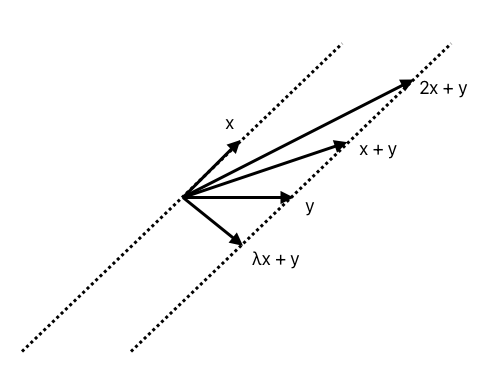
To prove that using general setting of inner product space, we need some geometric intuition first. Consider the fact that $\Vert \lambda x + y \Vert \ge 0$ for all $\lambda \in \mathbf{C}$, we need to first find $\lambda$ such that the norm is minimal.
Using $\mathbf{R}^2$ as example, we can see that the norm is minimal if $(\lambda x + y) \perp x$ so we have
\[(\lambda x + y) \cdot x = \lambda \Vert x \Vert^2 + y \cdot x = 0 \qquad \implies \qquad \lambda = - { y \cdot x \over \Vert x \Vert^2 }\]Therefore, with this particular value of $\lambda$, we have
\[\begin{align*} 0 \le \Vert \lambda x + y \Vert^2 &= (\lambda x + y) \cdot (\lambda x + y) \\ &= \vert \lambda \vert^2 \Vert x \Vert^2 + \lambda x \cdot y + \overline{ \lambda x \cdot y } + \Vert y \Vert^2 \\ &= {\vert x \cdot y \vert^2 \over \Vert x \Vert^2} - 2 { \vert x \cdot y \vert^2 \over \Vert x \Vert^2} + \Vert y \Vert^2 \\ \vert x \cdot y \vert &\le \Vert x \Vert \Vert y \Vert \end{align*}\]Moreover, $\Vert \lambda x + y \Vert = 0$ iff $y = - \lambda x$, i.e. a scalar multiple of each other.
More results regarding these specialized spaces can be found in inner product spaces.
References
- J C Burkill A Second Cource in Mathematical Analysis, 1970 - Chapter 2.2
- Dexter Chua Part IB - Analysis II, 2015 - Chapter 4